


Welcome back to the Pear Healthcare Playbook! Every week, we’ll be getting to know trailblazing healthcare leaders and diving into building a digital health and biotech business from 0 to 1.
We would greatly appreciate it if you took a moment to listen to the episode on either Apple or Spotify and leave us a rating! Your support helps our guests’ insights reach a larger audience!
Today we’re thrilled to share our interview with Arpan Parikh, MD and Amit Parikh, MD, and Kyle Alwyn, the co-founders of Kin Health, a free app that records patients’ doctor visits, turns them into a plain-English summary with next steps, and helps them act on what they were told. Kin closed a $9 million seed round with GoodRx co-founders Doug Hirsch and Trevor Bezdek joining as founding partners and executive chairmen.1 In this conversation, Arpan, Amit, and Kyle walk through the personal and professional catalysts behind Kin, how the company is borrowing (and adapting) the GoodRx playbook, how Kin complies with security and privacy, and how they think about consent in a world where both doctor and patient are now showing up to the visit with their own AI listening in.

If you prefer to listen:
The Origin of Kin
Arpan and Amit Parikh are brothers, and both are double board-certified psychiatrists. About four years ago, Arpan’s mother-in-law was diagnosed with breast cancer. She’s now in full remission, but coordinating her diagnosis, workup, and treatment as a family was difficult, even though the immediate family includes more than ten board-certified physicians. Arpan’s takeaway was that if a family with that much medical literacy and that many resources could barely pull it off, the average American patient starts every serious health journey at a disadvantage.
Amit, most recently Chief Medical Officer at Brave Health, was arriving at a similar idea from a different direction. Across the behavioral health companies he’d run, he kept seeing the same pattern where clinicians would do everything right in the room, the correct diagnosis, the correct medication, the correct tests, and patients still wouldn’t always get the outcomes they expected. The visit itself is only fifteen to thirty minutes, and almost all of the actual work of getting better happens afterward, taking the medication correctly, remembering the follow-up, watching for the right symptoms, and most patients simply aren’t equipped to do that part well.
Kyle had co-founded the telemedicine startup HeyDoctor, sold it to GoodRx, and spent the pandemic scaling the telehealth service before leaving in 2023. Along the way, he went through his own health scare and discovered that even with real clinical literacy on his side, it was surprisingly easy to fall through the cracks of his own care.
The three founders were brought together by a shared connection to Trevor Bezdek and Doug Hirsch, the co-founders of GoodRx. A mutual friend had introduced Arpan to Trevor in Los Angeles, where Arpan pitched him an early version of the idea: essentially, a scribe built for patients instead of doctors. Trevor and Doug were intrigued by the premise that the conversation between a patient and their doctor was itself a rich, largely untapped source of healthcare data, and Arpan soon brought Amit into the discussion.
At around the same time, Kyle had independently reconnected with Trevor, and the two had been trading ideas about what Kyle might build next. Trevor introduced Kyle to Amit, and the pieces quickly fell into place with all three founders arriving at the same problem from very different vantage points.
Before Kin, a patient walking out of a long appointment had a few unsatisfying options.
Scribble notes by hand during the visit, while also trying to absorb a diagnosis or bad news in real time.
Lean on a family member who happens to work in healthcare to translate and remember what was said, which is exactly the advantage Arpan’s own family had, and it still wasn’t enough.
Call the office afterward and hope someone had time to repeat the instructions, days after they actually mattered.
None of those options scale to the roughly one billion physician office visits that happen in the US every year.2 And even when patients do get something afterward, it is often buried behind a portal login or reduced to a discharge diagnosis, medication list, and a few next steps. What gets lost are the richer details of the conversation like why the doctor made a particular recommendation, what alternatives were discussed, what symptoms to watch for, and the context a patient may need weeks or months later to actually understand and act on their care.
How Kin Works
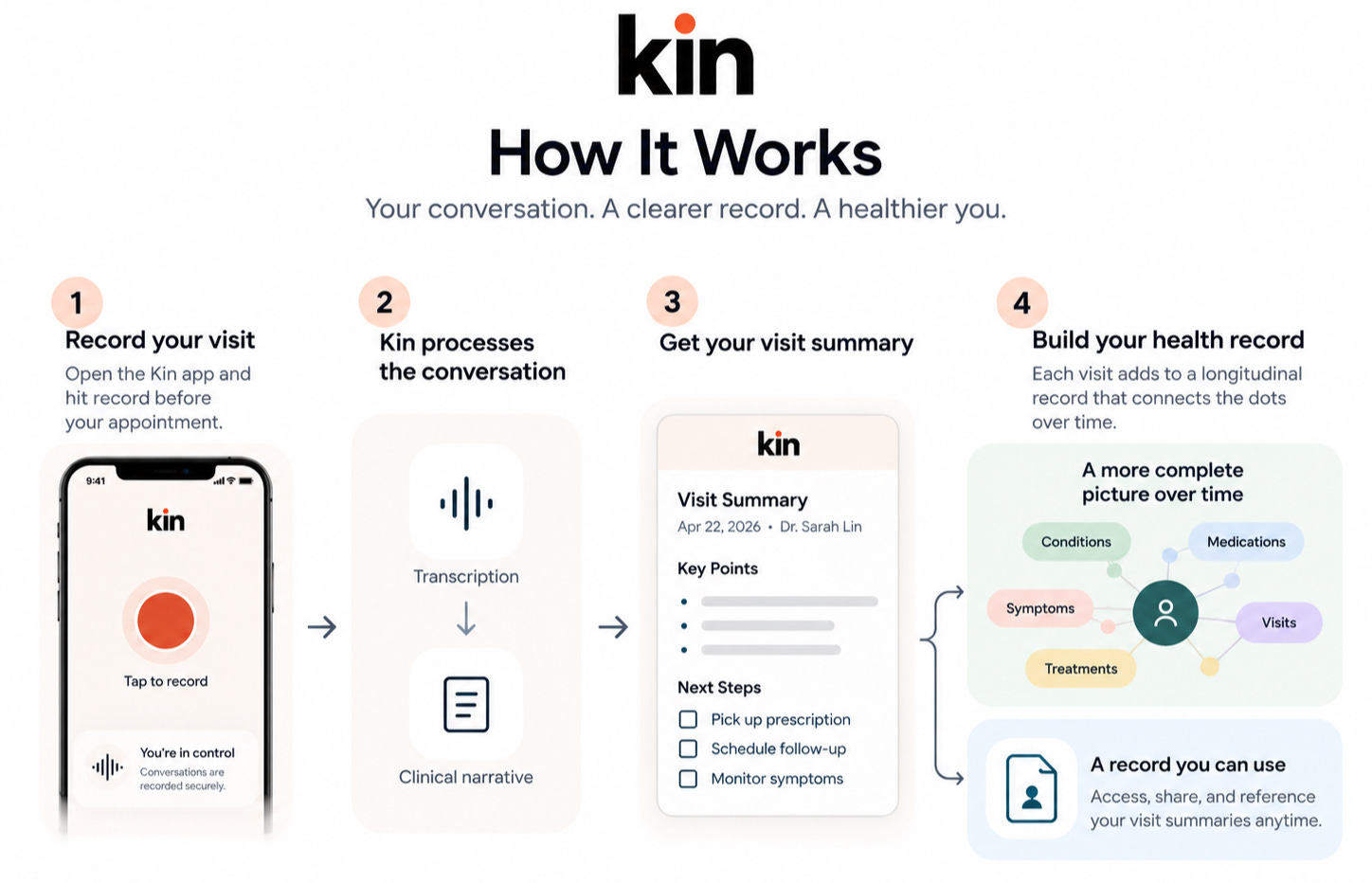
Patients can download the free Kin app onto their phone, and before a visit, they open the app and hit record. Kin captures the conversation, removes the filler words, and turns what matters into a summary written at roughly a fifth-grade reading level, with clear action items and next steps.
The app is built to work wherever patients receive care. Hospital basements, infusion centers, and even rural clinics often do not always have reliable connectivity, so Kin can record fully offline and sync once a connection returns. The conversation is then transcribed and converted into a clinical narrative from a third-person point of view.
Each conversation serves two purposes. The patient gets an understandable record of what happened and what they need to do next, while the information is also added to a longitudinal health record that builds with every visit.
Most medical records are organized around individual encounters. Kin structures the record as a graph of facts and relationships, connecting conditions, symptoms, treatments, and visits over time. Every new conversation adds more context, giving patients a record that reflects how their health has evolved and how different pieces of their care connect.
A Business Model Built on Never Charging Patients
A core part of Kin’s business is to never charge the patient. That draws directly from the model behind GoodRx, which built a free consumer product without asking patients to pay for access. A patient searching for a medication could use GoodRx to compare prices and get a discount, and when that patient used a GoodRx coupon at the pharmacy, the pharmacy paid a fee to the pharmacy benefit manager that processed the transaction, with GoodRx receiving a portion of that fee.3 GoodRx gave the patient something valuable for free and made money by participating in a transaction that was already going to happen elsewhere in healthcare.
Kin is applying that same idea to what happens during and after a doctor’s visit. The product first acts as an understanding layer, helping patients capture what happened in the exam room, understand what their clinician recommended, and share that information with family or caregivers. But most visits also create a series of next steps: a prescription to fill, a lab to complete, imaging to schedule, a specialist to see, or a follow-up appointment to book. Because Kin already has the context from the visit and knows what the clinician recommended, it can help the patient follow through on those next steps and eventually participate commercially in the transactions it helps facilitate. GoodRx built this model around the prescription. Kin’s opportunity is to extend it across the much broader set of healthcare decisions that come next, while keeping the product free for the patient.
Building for Trust Outside of HIPAA
The Health Insurance Portability and Accountability Act, better known as HIPAA, was passed by Congress in 1996 as healthcare was beginning to move more information and administrative transactions electronically. Among other things, the law led to national standards for protecting certain health information, but those protections were never written to cover every company or person that might come into contact with someone’s medical information. HIPAA instead applies primarily to what the law calls “covered entities”: health plans like insurance companies, healthcare clearinghouses that process health transactions, and healthcare providers like doctors and hospitals when they conduct certain transactions electronically. It also extends to “business associates,” the outside companies that handle protected health information on behalf of those covered entities, such as a software vendor hired by a hospital to store patient records.4
Kin sits outside of that structure. It isn’t a hospital, physician practice, insurer, or healthcare clearinghouse, and it isn’t being hired by one of those organizations to handle patient information on its behalf. The patient chooses to use Kin directly and brings their own health information into the product. That distinction matters. HHS has explained that when a patient sends health information to a consumer app that is neither a covered entity nor a business associate, the information in that app generally is no longer protected by the HIPAA Rules.5 The same principle applies to many consumer health products people use every day: health information does not automatically become subject to HIPAA simply because it is medical or sensitive. What matters is who holds the information and the role they are playing.
For Kin, HIPAA may not require the company to follow the same rules as a hospital, but patients are still trusting Kin with recordings of doctor’s visits and some of their most personal health information. The team has built access controls, permissioning, and data redaction with the expectation that its privacy and security standards should look more like those of a healthcare organization than a typical consumer app.
Clinical accuracy is another area where Kin has invested heavily. The company has built a dedicated team focused on clinical validity and rigor, alongside industry-leading evaluation pipelines for clinical voice data. Its clinical evaluation pipeline tests the entire chain from raw audio through the final patient-facing summary, with clinical experts reviewing both flagged and unflagged cases and ongoing monitoring designed to catch changes in model performance over time. HIPAA may not provide the regulatory framework for Kin, but the company still has to earn the level of trust patients expect when they share information about their health.
Consent in the Age of Ambient AI
Recording a doctor’s visit is governed by a combination of federal and state laws. Federal law generally follows what is known as “one-party consent,” meaning that a conversation can be recorded when at least one person participating in it has consented. Most states follow a similar approach: 38 states, along with the District of Columbia, generally permit one-party recording, while 12 states are commonly classified as requiring the consent of all parties to certain private conversations. The precise rules vary by state and by the circumstances of the conversation.
Under California’s Invasion of Privacy Act, a “confidential communication” generally cannot be recorded without the consent of all parties, with confidentiality determined in part by whether the people involved reasonably expected that the conversation was not being recorded or overheard.6
For Kin, the important distinction is that the patient is part of the conversation being recorded. In states that follow one-party consent, the patient’s own consent will generally be enough. In states with stricter requirements, including California, the clinician may also need to consent when the visit qualifies as a confidential communication. Kin encourages all users to tell their clinician that they are using the app before recording begins, and the app includes prompts to make that easier. In practice, the request can be as straightforward as explaining that Kin helps the patient remember what was discussed and understand what they need to do after the visit.
This is also becoming a more familiar conversation in healthcare because clinicians are increasingly using ambient AI scribes themselves. These products listen to the conversation between a patient and clinician and use AI to generate a draft of the clinical note. Adoption has happened quickly in some health systems. Kaiser Permanente made an ambient scribe available to 10,000 physicians across 21 locations in Northern California, and within ten weeks, 3,442 physicians had used it across more than 300,000 patient encounters.7 At Stanford, a three-month study across eight ambulatory specialties found that participating physicians used an ambient AI scribe in 9,629 of 17,428 eligible encounters, or about 55% of visits.8
There is no single national standard for how clinicians need to obtain consent before using an ambient scribe, and practices differ across health systems and states. Many health systems have made patient consent part of the workflow. Kaiser Permanente obtains consent from the patient before using its ambient scribe and has reported that approximately 95% of patients agree.9 For patients using Kin, the direction of that conversation is reversed. The clinician may already be accustomed to asking whether an AI tool can listen to the visit to help with documentation; Kin asks the patient to have a similar conversation with the clinician so the patient can use AI to remember and understand what happened.
The Competition for the Medical Conversation
Kin is entering a market where the medical conversation has already become valuable real estate. Over the past several years, Abridge, Ambience, Nabla, Heidi Health, Suki, Freed, and a growing number of other companies have built products that listen to visits and turn what was said into structured documentation for clinicians. The category has grown quickly and attracted significant capital. Abridge raised $300 million in mid-2025 at a $5.3 billion valuation, roughly twice its valuation four months earlier, while Microsoft has expanded Dragon Copilot and Epic has introduced its own AI Charting capabilities.9 The leading independent companies are also expanding beyond documentation into coding, billing, orders, and other clinical and administrative workflows surrounding the visit. The result is an increasingly crowded and well-funded market for capturing the conversation between a patient and their clinician.
Kin is competing for that same conversation, but it is building for the person on the other side of it. A health system buys Abridge or Ambience because it wants to reduce documentation burden, make clinicians more productive, and increasingly automate work that follows the visit. The resulting information is primarily designed to flow into the medical record and the provider’s workflow. Kin records the visit for the patient, translates it into something they can understand, and gives them a record they can return to after leaving the office. That creates a different product and distribution model. A provider-facing scribe is typically tied to the clinician or health system that purchased it; Kin can follow a patient from a primary care visit to a specialist consultation to an emergency department encounter, including across organizations whose medical records may not communicate cleanly with one another.
The distinction does not put Kin beyond the reach of the provider-facing companies. Abridge, Ambience, Microsoft, Epic, and others already have access to the same underlying conversation, substantial engineering resources, and distribution through clinicians and health systems. Some are already moving closer to the patient. Microsoft Dragon Copilot, for example, can generate after-visit summaries from an encounter, although the product remains centered on the clinician and requires clinician review of generated content. Epic has an equally natural path to deliver more of the information captured during a visit through its patient-facing products. Over time, Abridge and other independent scribes could do the same. Kin therefore has to build more than a better summary and product. Its advantage has to come from owning a patient relationship that persists across encounters and providers, rather than producing another output from a single visit.
Fundraising as a Team Sport, and Where Kin Goes Next
Kin approached fundraising as a team effort. When pitching investors, the entire five-person team would sometimes show up together instead of leaving the fundraising to a single member of the team. Each person brought a different perspective and set of relationships, but their presence together also reflected how the company had been built. The team spans consumer technology, healthcare, and company building, and they wanted their investors around the table to bring similarly different perspectives.
The founders ultimately want Kin to become a patient-owned health graph, accumulating context from the many places a person’s care actually happens, including encounters that rarely make it into the same medical record. Roughly a quarter of visits recorded on Kin today are already done on behalf of someone else, including a parent or child and, more recently, even a pet. Over time, the team imagines those individual records connecting into family-level graphs and eventually providing useful context not only to patients, but also to the clinicians and AI-native care platforms caring for them.
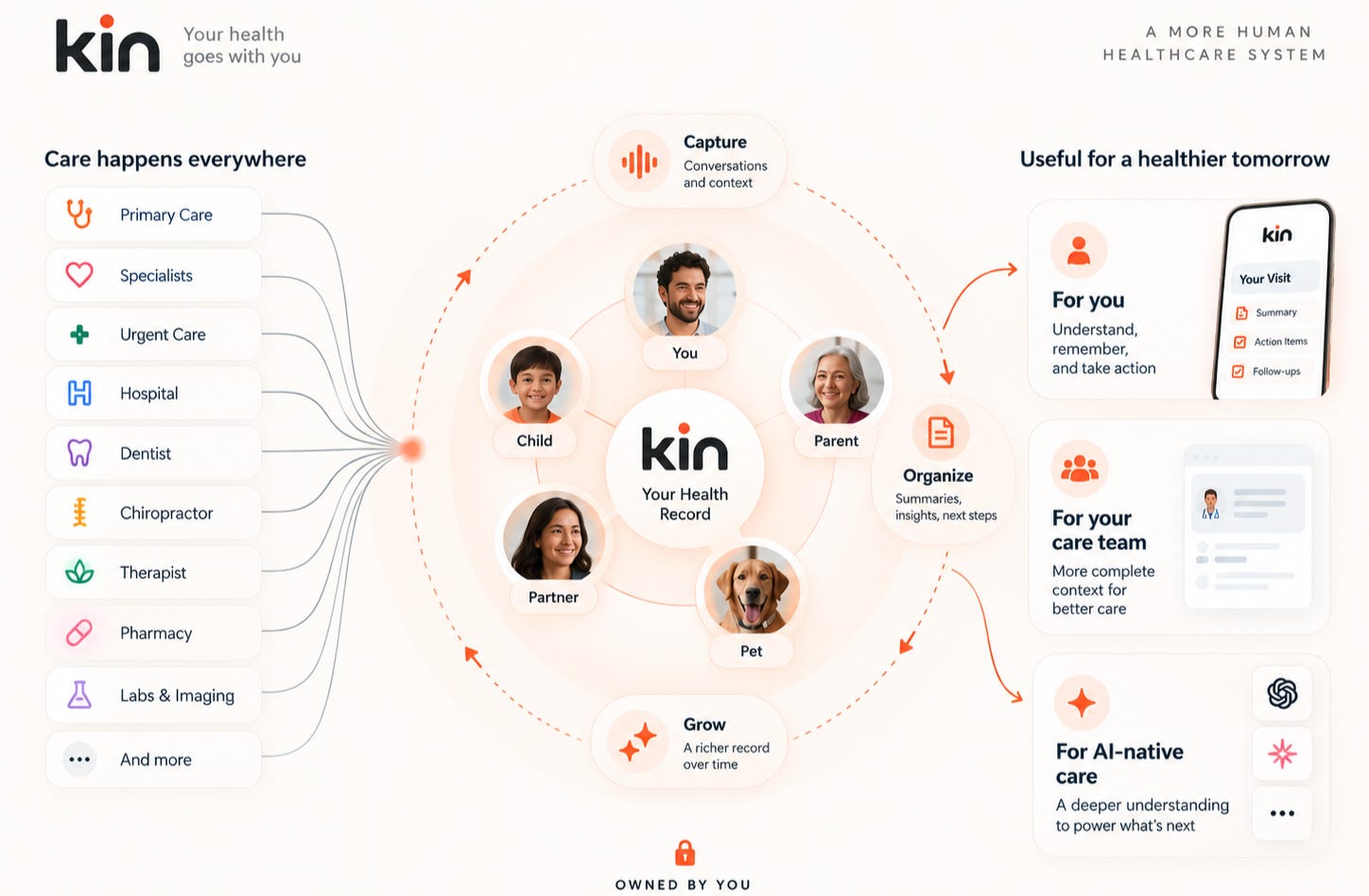
Kin Health is a free app that records doctor visits and turns them into plain-language summaries, action items, and a patient-owned longitudinal health record. Learn more at meetkin.com.
Sources:
Super interesting! Patient empowerment is so important!
Absolutely loved this conversation!!!